Seven cosmetic scores, not one vague verdict
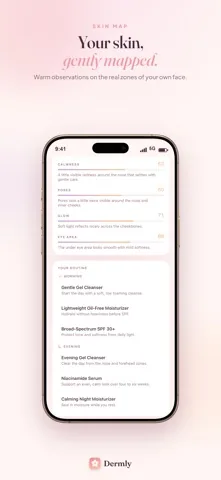
Clarity, Smoothness, Tone, Calmness, Pores, Glow and Eye Area, each with an observation pointing at a real zone on your photo. An overall score sits on top of the seven.
 Dermly
Free on the App Store
One selfie becomes seven cosmetic skin scores, a skin age estimate and a personal AM and PM routine, with the photo deleted straight after the analysis.
No account. No email. 11 languages. iOS 26.0 or later.
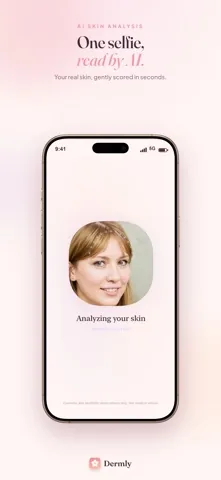
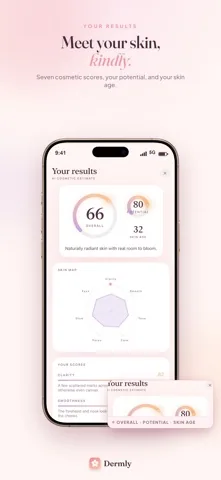
Dermly is a free iPhone app that turns a single selfie into an AI skin analysis. It returns an overall score, seven cosmetic sub scores (Clarity, Smoothness, Tone, Calmness, Pores, Glow and Eye Area) and a skin age estimate, then builds a personal AM and PM skincare routine and a 12 week trajectory. Every observation points at a real zone on your own photo. Dermly describes appearance only and gives no medical advice.
How a scan works
A guided capture screen puts your face in an oval and tells you when the light is too low. One photo in good light is all it takes.
Your selfie is sent once, analyzed by Anthropic Claude, and deleted. Back comes an overall score, seven sub scores, a skin age estimate and a note tied to a real zone on your own face.
A short AM and PM routine at the category level, plus a 12 week trajectory showing where consistent care could take those numbers.
From the app
Seven cosmetic dimensions
What you get
Clarity, Smoothness, Tone, Calmness, Pores, Glow and Eye Area, each with an observation pointing at a real zone on your photo. An overall score sits on top of the seven.
One cosmetic number for how your skin presents in the photo. It is an estimate of appearance, not a measurement of your body.
Cleanser, moisturizer, SPF and proven actives, chosen for what the scan saw and the goal you picked. Dermly names categories, never brands, so nothing is being sold to you.
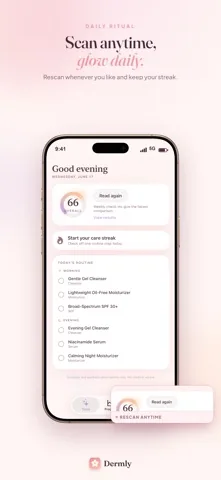
Rescan each week to see score deltas and a photo timeline. The trajectory is a projection of steady care, and the app says so: an estimate, not a guarantee.
The model runs at temperature zero, so the same photo always returns the same numbers. Changes you see across weeks come from your skin, not from the dice.
No email, no sign up, no profile. Your selfie is analyzed once with your consent and then deleted. Scans and photos are kept on your iPhone only.

Free to download. iPhone, iOS 26.0 or later.
Who it is for
Scan before you change anything, then keep scanning weekly. The score deltas and the photo timeline tell you whether the new serum did something or whether you just liked the packaging.
Dermly builds four to six steps split across morning and evening, at the category level. It is the short version, built from your own scan rather than from a generic skin type quiz.
Seven separate scores mean you can see that Tone dropped while Smoothness held. A single overall verdict hides exactly the detail you need.
Fair. Dermly writes out exactly where the photo goes, who processes it, and how long it exists. If that answer does not satisfy you, do not install it.
11 languages
Skincare advice is hard to follow in a second language, so Dermly does not ask you to. The interface and the analysis both follow your device language, which means the observations, the routine steps and the reminders come back in the one you think in.
FAQ
Dermly is free to download from the App Store and needs no account, no email and no sign up. Your full results, the personal AM and PM routine, the 12 week projection and progress tracking require a Dermly Pro subscription, which is 3.99 US dollars per week or 12.99 US dollars per month and renews until you cancel in your iPhone Settings.
You take one guided selfie. The app sends it once, with your explicit consent, to the Dermly server, which forwards it to the Anthropic Claude vision model. The model returns an overall score, seven cosmetic sub scores (Clarity, Smoothness, Tone, Calmness, Pores, Glow and Eye Area), a skin age estimate and a suggested AM and PM routine. Each observation points at a specific zone of your own photo.
On a server. Your selfie is compressed on the phone, sent over an encrypted connection to the Dermly analysis endpoint, and passed once to the Anthropic Claude API. Nothing about the image is written to disk or logged; the server keeps only a status code, a response time and a language tag. After the response comes back, the image is gone from the server. The scores, your photos and your history are then stored on your iPhone only.
No. Dermly gives cosmetic and aesthetic observations about how your skin looks in a photo. It is not a medical device, it performs no diagnosis and it is not a screening tool of any kind. It cannot tell you whether anything on your skin is harmless or serious, and it never tries. If something worries you, changes, hurts or will not heal, book a dermatologist. An app is not a substitute for that appointment.
It is analyzed once and then deleted. It is never stored on the Dermly servers, never used to train an AI model and never sold. Your scores and routine live only on your iPhone, and the selfies kept for the photo timeline are stored in a folder that is excluded from iCloud and device backups. You can erase all of it from the app settings in one tap.
Eleven: English, German, Spanish, French, Italian, Brazilian Portuguese, Turkish, Arabic, Japanese, Korean and Simplified Chinese. The interface and the analysis both follow your device language, so the observations and the routine come back in the language you actually think in.
An iPhone on iOS 26.0 or later, the camera or a photo from your library, and an internet connection for the analysis itself. It does not analyze offline. Once a scan is done, your results, routine and history are readable on the device without a connection.
What your skin score means
The seven cosmetic dimensions Dermly reads, and how to make sense of each number.
Skin age test
What an AI skin age estimate is, what it is not, and why it moves between photos.
Build a skincare routine
A four step AM and PM routine at the category level, without a 12 step shopping list.
Track skincare progress
How to photograph and measure your skin so a twelve week change is actually visible.
Where your selfie goes
The honest answer: a server, once, then gone. Written out step by step.
App or dermatologist
What a phone camera can answer, and the much longer list of what only a doctor can.
Seven cosmetic scores, a skin age estimate and a routine you can keep, from a single selfie that is deleted as soon as it has been read.