
Progress tracking
How to tell whether your skincare routine is actually working
Before and after photos prove nothing unless the two photos were taken the same way. Here is the method, and what a weekly score can add to it.

Free on the App Store
Five things to hold still
Everything below is free and takes no app. Do these and your own camera roll becomes evidence instead of decoration.
- One room, one spot. Pick a place and never move. Facing a window works better than any ceiling light, because overhead light invents under eye shadow.
- One time of day. Morning light, evening light and a bathroom bulb are three different colours. Skin does not change that fast; the bulb does.
- One distance and angle. Arm at the same extension, phone at eye level, chin neither up nor down. Distance alone changes how visible pores read.
- A bare face. No makeup, no fresh product, no filter. If the camera app is smoothing your skin, turn that off first.
- Twenty quiet minutes first. Not straight out of a hot shower, not straight off a run. Both leave the face flushed for a while.
What Dermly adds on top of the photos
A guided frame
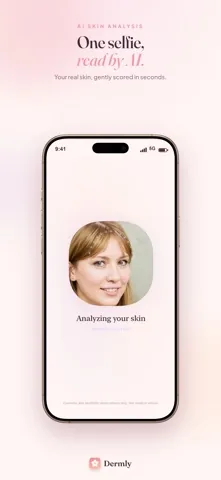
The capture screen puts your face in the same oval every time and tells you when the light is too low, which quietly handles two of the five variables above.
Numbers, not impressions
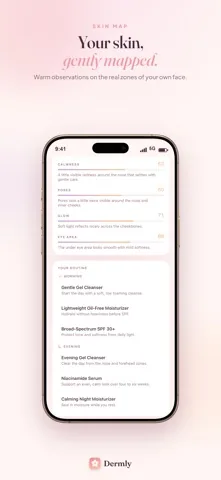
Seven cosmetic scores per scan and the delta from last week, so you can see Tone rise while Calmness holds. Your eye cannot separate those on a photo pair.
A photo timeline
Every scan keeps its selfie on your phone, in order, so the numbers always have the image that produced them sitting next to them.
Fixed scoring
The same photo always scores the same, because the model runs at temperature zero. Any movement you see comes from the input, never from the scorer.
A twelve week experiment worth running
Scan once before you change anything. Change exactly one thing. Keep the routine for twelve weeks, scanning weekly under the same conditions. At the end, read the sub score that the change was supposed to move, not the overall number.
If nothing moved, you have learned something real and cheap. That is worth more than another product on the shelf.
Progress tracking questions
How often should I take progress photos of my skin?
Weekly. Daily photos mostly capture sleep, salt and light, and the noise drowns the signal. Skin turns over slowly enough that a week is the shortest interval at which a real change can appear. Dermly is built around a weekly rescan for exactly this reason and will remind you when one is due.
Why do my before and after photos look so different when nothing changed?
Because you changed the photo. Light direction, colour temperature, camera distance, head angle and time of day move a face more than four weeks of a good routine does. This is also why marketing before and after images are so easy to fake: soft front light after, hard overhead light before, same face, same day.
How do I make two photos actually comparable?
Fix five things and keep them fixed: the same room, the same light source at the same time of day, the same distance from the lens, the same head angle, and a bare face with no makeup. Standing facing a window on an overcast morning is the easiest repeatable setup most people have. Dermly guides your face into the same oval every time, which handles distance and angle for you.
Can I trust a score change of a few points?
Only if the conditions held. Dermly scores at temperature zero, so an identical image always yields identical numbers, which means the scoring itself contributes no drift. What drifts is the photograph. Under controlled conditions a several point move across a few weeks is meaningful; under uncontrolled conditions it is lighting.
What is the 12 week trajectory?
A projection of where consistent care could take your scores over twelve weeks, drawn from your current scan and your goal. It is a forecast, not a promise, and the app says so on the screen. Its real job is to set the right expectation: that visible change takes about a quarter of a year, not a weekend.
Where are my progress photos kept?
On your iPhone. The selfies used for the photo timeline are written to a folder that is deliberately excluded from iCloud and from device backups, so they do not travel to another machine. Scan results live in a local database on the same device. One tap in settings deletes every scan, photo and setting.
Start the twelve week experiment this week
Dermly is free to download on the App Store. No account, no email, no sign up. Available in 11 languages.
More on reading your own skin
What your skin score means
The seven cosmetic dimensions Dermly reads, and how to make sense of each number.
Skin age test
What an AI skin age estimate is, what it is not, and why it moves between photos.
Build a skincare routine
A four step AM and PM routine at the category level, without a 12 step shopping list.
Where your selfie goes
The honest answer: a server, once, then gone. Written out step by step.
App or dermatologist
What a phone camera can answer, and the much longer list of what only a doctor can.