
Skin age
Skin age test: what the number is, and what it is not
A skin age test answers one narrow question: how old does the skin in this photograph look? That is a real, useful question. It is also a much smaller question than most apps let on.

Free on the App Store
What the estimate is built from
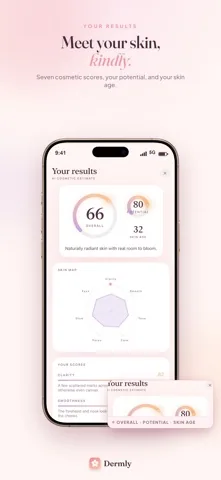
Dermly produces the skin age estimate from the same selfie as the seven cosmetic scores, and it draws on the same visible signals. Nothing else about you goes into it, because nothing else is available: there is no account, no health record and no history to consult.
- Surface texture. Fine lines, roughness and how uniform the surface reads at the resolution of a phone camera.
- Tone evenness. How consistently colour sits across the face rather than pooling in patches.
- The eye area. Shadowing, puffiness and crepiness under the eyes, which is where photographs age a face fastest.
- Light return. Whether the surface reflects light or reads as flat.
Three honest limits
It reads a photo
Change the light and you change the estimate. The face did not change; the image did.
It is not biology
No selfie carries the information a laboratory measurement would. The number describes appearance only.
There is no standard
No published clinical scale defines skin age. Every app that reports one is reporting its own model, including this one.
The useful way to take the number
Treat it as a trend line, not a verdict. One estimate is a snapshot of a photograph taken under one set of conditions. A series of estimates taken in the same room, in the same light, at the same time of day, over three months, is a genuine signal about whether what you are doing is showing up on your face.
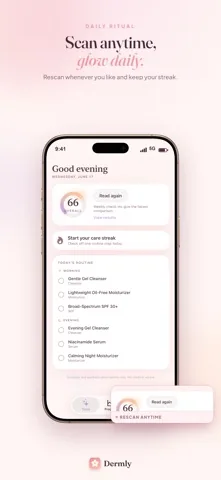
Dermly pairs the estimate with a 12 week trajectory: a projection of where consistent care could take your scores. The app labels it an estimate rather than a guarantee, and it is worth taking that label literally.
Skin age questions
What is a skin age test?
A skin age test estimates how old the skin in a photograph looks, in years. In Dermly it is produced from the same single selfie as the seven cosmetic scores, and it reflects the visible signals the model can see: surface texture, how evenly colour sits across the face, how the under eye area reads, and how light reflects off the surface. It is one cosmetic number about a picture.
Is skin age the same as biological age?
No. Biological age is a claim about your body and would need laboratory measurement to support. A skin age estimate is a claim about a photograph. Dermly makes only the second kind of claim. If an app tells you your biological age from a selfie, it is describing appearance and calling it biology.
Why is my skin age lower or higher than my real age?
Because the two are measuring different things. The estimate describes how the skin presents in that image, and the image is shaped by light, sleep, hydration, camera distance and whether you are wearing makeup. It is very common for the number to sit several years either side of your actual age, and neither direction means anything on its own.
Why did my skin age change between two scans on the same day?
Almost always the photo, not the face. Under eye shadow deepens with an overhead light and vanishes with a window in front of you. Texture appears under hard side light and disappears under soft light. Scan in one consistent spot if you want the number to be comparable week to week.
Can I lower my skin age?
You can change some of what the estimate reads, which is not the same promise. Hydration, sleep, daily sun protection and consistency move visible texture, tone evenness and the under eye area over weeks and months. Dermly builds an AM and PM routine aimed at exactly those visible signals, and shows a 12 week trajectory as a projection of steady care. The app calls that an estimate, not a guarantee, and so do we.
Is a skin age estimate medical information?
No. It is a cosmetic observation about a photograph. It says nothing about your health, it is not a diagnosis and it does not replace a doctor. Any concern about your skin belongs with a dermatologist, not with an app.
Get your skin age estimate from one selfie
Dermly is free to download on the App Store. No account, no email, no sign up. Available in 11 languages.
More on reading your own skin
What your skin score means
The seven cosmetic dimensions Dermly reads, and how to make sense of each number.
Build a skincare routine
A four step AM and PM routine at the category level, without a 12 step shopping list.
Track skincare progress
How to photograph and measure your skin so a twelve week change is actually visible.
Where your selfie goes
The honest answer: a server, once, then gone. Written out step by step.
App or dermatologist
What a phone camera can answer, and the much longer list of what only a doctor can.